 Kinetic Leadership Development
 Kinetic Leadership Development

Jump to section
- What is the difference between a founder and a CEO?
- Why does my team stop treating me like the boss?
- What is the Delegation Filter for a CEO?
- How do I go from founder to CEO?
- What decisions should a CEO keep?
- How do I stop redoing my team’s work?
- Where does a CEO get feedback when nobody is above them?
- How long does the shift from founder to CEO take?
- Does becoming the CEO mean pulling away from your team?
- Frequently asked questions
The difference between a founder and a CEO is mostly what your team watches you do. Your team decides whether you’re the CEO from what they see you spend your time on, and when all they see is you doing their jobs, they probably treat you like one of them.
Maybe you’re reading this between two jobs that aren’t yours, and stepping back feels risky because the newest advice says to stay in the details. That’s a fair worry, and you don’t have to step back to fix this.
[VIDEO EMBED: Founder vs CEO: What Your Team Needs to See You Do]
Below are four steps to change what your team sees, one leader’s story through the first three (her story hasn’t reached the fourth yet), and scripts for the team meeting, a new hire’s first one-on-one, and the moment before you redo someone’s work.
What is the difference between a founder and a CEO?
A founder and a CEO are different jobs, and your team tells them apart by watching where your time goes. If they mostly see you doing the work they do, they’ll usually relate to you as a peer.
The classic advice was to hire great people and get out of their way. Airbnb’s CEO, Brian Chesky, called that “a death sentence to a young company” in his How I Built This interview, and said you have to stay really close to the company. So now the advice has flipped: stay in the details. Both sides are arguing about how involved you should be.
None of it asks what your team sees you doing.
A leader I coach, who built her organization from the ground up, was living this in September. A manager she’d just promoted went around her, and she realized that manager had probably never been in a meeting with her. Around then, she told me, “I feel like I’m in prison.” I’ll follow her through the steps below.
Why does my team stop treating me like the boss?
Your team often stops treating you like the boss because they rarely see you doing the boss’s job. When nobody is above you, your team can also become the place you go for approval, and they can usually tell.
She’d moved someone from a part-time hourly job to full-time manager, because she thought she was great. Then she sent her staff a new process for answering the public and asked for their feedback. The new manager wrote back, “this is great timing because I and a couple of other managers got together to decide how we’re going to do some uniform responses.”
She wondered if it was because “she has never been in meetings with me.” What her newer staff saw was her “saying hello to them on the floor and giving them a big hug.” Then she said, “how do you know what leadership is if you don’t get to see it directly, right?”
Technically the board is her boss, but in her words, “No one ever checks in on me.” She said, “I think that led to me sort of behaving with my direct reports as if they are my peers. And then I’m looking to them for positive reinforcement, which is not healthy and not strategic.” If that sounds familiar, my guide to people-pleasing at work goes deeper on needing your team’s approval.
It cost her. One of her senior people got comfortable debating her decisions in front of another direct report, and there was an annual review she wasn’t sure she could give, because the relationship was “too messy.”
What is the Delegation Filter for a CEO?
The Delegation Filter sorts your work into three columns: Zone of Genius, Stamp of Approval and Pass the Baton. For a CEO, Zone of Genius means the work only the CEO can do.
- Zone of Genius is the work you keep.
- Stamp of Approval is work someone else does and you check before it goes out.
- Pass the Baton is work you hand off completely.
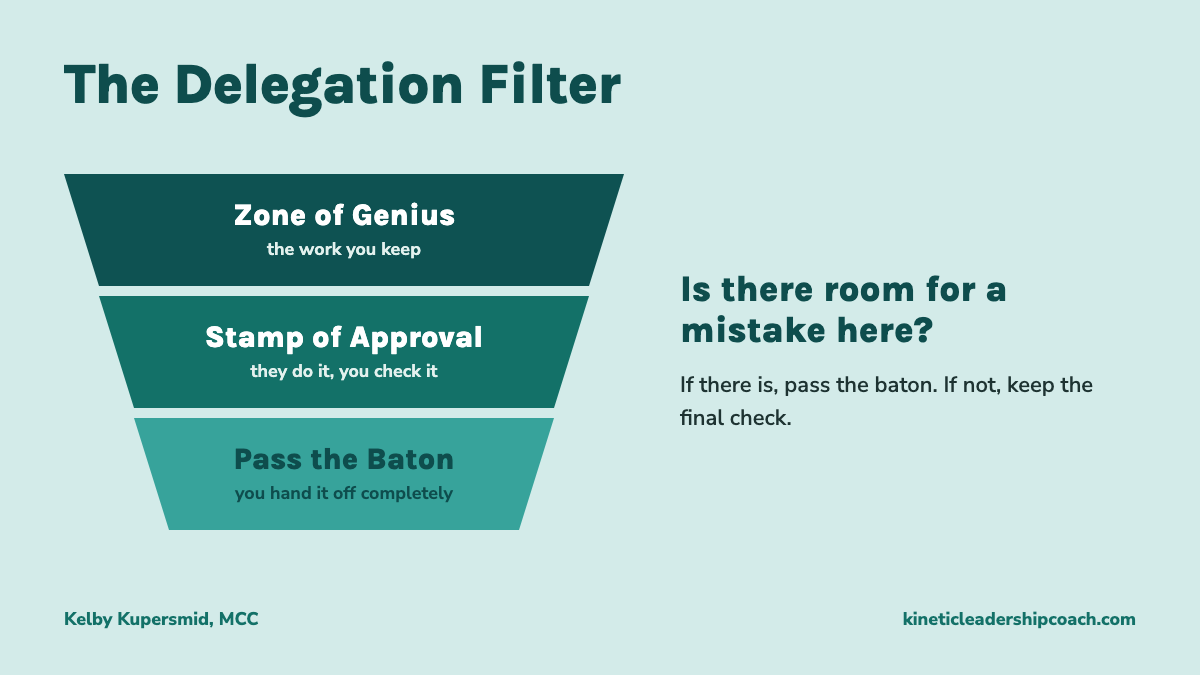
To decide between the last two, ask: is there room for a mistake here? If there is, pass the baton. If not, keep the final check. My guide to delegation for founders walks through the full Filter. For the founder-to-CEO shift, you fill it in over four steps:
- Name the work only you can do
- Let them see it
- Write down who decides what
- Ask before you redo
How do I go from founder to CEO?
You go from founder to CEO by naming the work only the CEO can do, making sure your team sees you do it, writing down who decides what, and asking before you redo anyone’s work.
Step 1: Name the work only you can do
Write down the three or four things only the CEO can do in your company. For her, it was bringing in money, the big high-level meetings, and setting goals for the senior person she was about to hire. Then open last week’s calendar and check it against that list.
In early November she’d secured some large amounts of money, with big meetings coming up. And she couldn’t enjoy it, because in fifteen minutes she had to walk into an HR meeting. She said, “this should not be what I’m doing. Somebody else should be doing this.” When work like that drains you week after week, it’s worth reading about founder burnout too.
The mistake is listing what you’re good at. The question is whether only the CEO can do it.
Fill in this line: “The work only I can do is ___, ___ and ___.” When you move something off your plate, say it out loud:
“Starting this week, ___ is yours. I’m moving that time to ___. If it comes to me, I’ll send it to you.”
The Delegation Filter workbook has the task grid and handoff scripts as fill-in-the-blanks, so you can sort last week’s calendar in one sitting.
Step 2: Let them see it
Once you’re doing the CEO’s work, your team needs to see it. Tell them what you’re landing, and bring newer managers into meetings you run.
Right after that, I asked her, “What’s great about it?” That’s when she named what her team needs: “when they don’t see me doing those big parts of my job, this is a group of people who can get pretty entitled about their own accomplishments. And we work a lot better when they see me as the captain of the ship.”
Telling a couple of her staff what she was landing, she said, was “like rocking the baby back to sleep.” And she planned to loop the manager who’d gone around her into her standing meeting with directors.
Script for your next team meeting:
“Quick update on what I’m working on. We’re close on ___, and I’m meeting ___ next week. Here’s what it would mean for us.”
And for a newer manager: “I’d like you to sit in on my meeting with the directors on Thursday. I want you to see how we make calls.”
The mistake is sharing wins to get praise back. If you’re waiting for a compliment after the update, you’re back to looking to your team for approval.
What decisions should a CEO keep?
A CEO should keep the decisions only the CEO can make, and write down which decisions belong to everyone else. If your team still brings you every decision, it’s probably because nobody wrote down what’s theirs.
Step 3: Write down who decides what
She was about to bring in a director of operations, so I sent her a one-page document. On our last call she read it out loud: “Before she starts, write down what she owns. One page, three lists. Decisions she makes on her own. Decisions she makes and tells you about afterwards. Decisions she brings to you first.”
With someone more experienced, she told me, she’d have just said “anything that seems major, bring it to me,” and been “too generous, too easy, too boundaryless.” That leaves you as the only one who knows what counts as major, so every unsure call comes back to your desk.
On the Filter, the first two lists go under Pass the Baton, and the third under Stamp of Approval.
Script for the first one-on-one with a new hire:
“Before you start, let’s write down what you own. Decisions you make on your own, decisions you make and tell me about afterwards, and decisions you bring to me first.”
How do I stop redoing my team’s work?
Stop redoing your team’s work by asking them what doesn’t work before you touch it, and then waiting for their answer. Redoing it for them takes away their chance to apply it themselves.
Step 4: Ask before you redo
Her story hasn’t reached this step yet, so this one comes from a different leader I coach, who reports to a CEO. He used to handle his team’s drafts like this: “I’ll redo it. I’ll show you how I redid it.” He realized that took away their chance to apply it themselves.
So when someone on his team brought him a slide deck for their CEO, he said, “tell me what doesn’t work here.”
Redoing usually comes from thinking that we provide value by doing. As a CEO, your value comes from evoking, or bringing out greatness in your team.
For her, I’d expect this step once the new director of operations starts and work lands on her desk that she’d rather fix herself. Since she hasn’t had that moment yet, the script below is my suggested wording for it, borrowed from his line, not something she said.
Suggested script for when you’re about to redo someone’s work:
“Tell me what doesn’t work here.”
If they hand the decision back, try the words I use with clients: “I notice you’re waiting for me to decide. Is that true?” And if the work comes back to you anyway after you’ve handed it off, don’t be the first to reply. Send it back with one line: “Looping in ___, who’s taking care of this now.”
The mistake is asking the question and then answering it yourself. Ask it, and wait.
Where does a CEO get feedback when nobody is above them?
A CEO with nobody above them can get feedback from peers outside the company and from board members who’ll give a good word if asked. That makes it easier to stop needing your team’s approval.
For her, that meant “more time and more energy with my peers… outside of the organization,” and the two people on her board who’ll give her a good word if she asks. You could say: “I’d find it useful to hear from you more often, including what’s going well. Could we do a short check-in once a month?”
To hear more from the people around you, use my 360 feedback template. For someone outside the company to think it through with, here’s what an executive coach for founders does.
How long does the shift from founder to CEO take?
For the leader in this post, everything here happened in under three months, from September to November. You don’t have to be born a CEO to make this shift.
By November, she’d offered the director of operations job, brought in significant money, and said, “I’ve actually been able to do a little bit more of my leadership stuff.” She’d been reading her team as people waiting for her to look weak. Now she said, “they don’t want the captain of the ship to be weak so they can take over the boat. They want the captain of the ship to be tough and strong.” Her being her “big, strong self” makes them feel safe.
Not everything moved. Her new hire sent a disappointing email right after accepting, and in early November she was still walking into HR meetings she says somebody else should handle.
Does becoming the CEO mean pulling away from your team?
Becoming the CEO doesn’t mean pulling away from your team. Reading “they need to see the CEO” as permission to distance yourself from them can undo the rest of this work.
In September, she planned to quietly distance herself from one staffer, a boundary the other person wouldn’t know existed. I told her, “this is where you might be creating a prison for yourself.” If something has to change, say it out loud: “Going forward, I’m going to ___.”
If the friction is across your whole leadership team, my guide to leadership team alignment is the next thing to read, and the Executive Alignment Retreat is how I work on it with a whole team.
Today, write down the three or four things only you can do, check last week’s calendar against them, and tell one person on your team what you’re landing this week.
The Delegation Filter workbook walks you through sorting your work into the three columns, with the handoff scripts as fill-in-the-blanks.
If you’d like to work on this shift one-on-one, that’s what my executive coaching for founders is for.
Frequently asked questions
What is the difference between a founder and a CEO?
Founder and CEO are different jobs, and your team decides whether you’re the CEO from what they watch you do. If all they see is you doing their jobs, they’ll probably treat you like one of them.
What work should a founder keep when becoming CEO?
Keep the three or four things only the CEO can do in your company, then check last week’s calendar against that list. For one leader I coach, it was bringing in money, the big high-level meetings, and setting goals for a senior hire.
How do I stop my team from bringing me every decision?
Write down three lists for each person: decisions they make on their own, decisions they make and tell you about afterwards, and decisions they bring to you first. Saying “anything major, bring it to me” leaves you as the only one who knows what counts as major.
Is staying in the details the same as micromanaging?
Staying in the details doesn’t have to mean micromanaging. You can stay close to the work by asking questions such as “tell me what doesn’t work here” before you redo anything. Ask the question and wait for the answer.

Kelby Kupersmid, MS, MCC
Kelby Kupersmid is a Master Certified Coach (MCC) who helps founders become CEOs and leadership teams work as one. He has coached leaders for 13+ years across 35+ countries.
Master Certified Coach (MCC), the International Coaching Federation’s highest credential · M.S., Global Business Leadership · Former program manager, Center for Creative Leadership
Published November 26, 2026