 Kinetic Leadership Development
 Kinetic Leadership Development
Jump to section
- What is 360 feedback?
- Who should you ask for 360 feedback?
- Is 360 feedback anonymous if you run it yourself?
- What should a 360 feedback invite say?
- What are the best 360 feedback questions?
- How do you get honest answers when you’re the boss?
- How do you write a 360 feedback report?
- What should you do after you get 360 feedback?
- When should you bring in someone else to run 360 feedback?
- Frequently asked questions
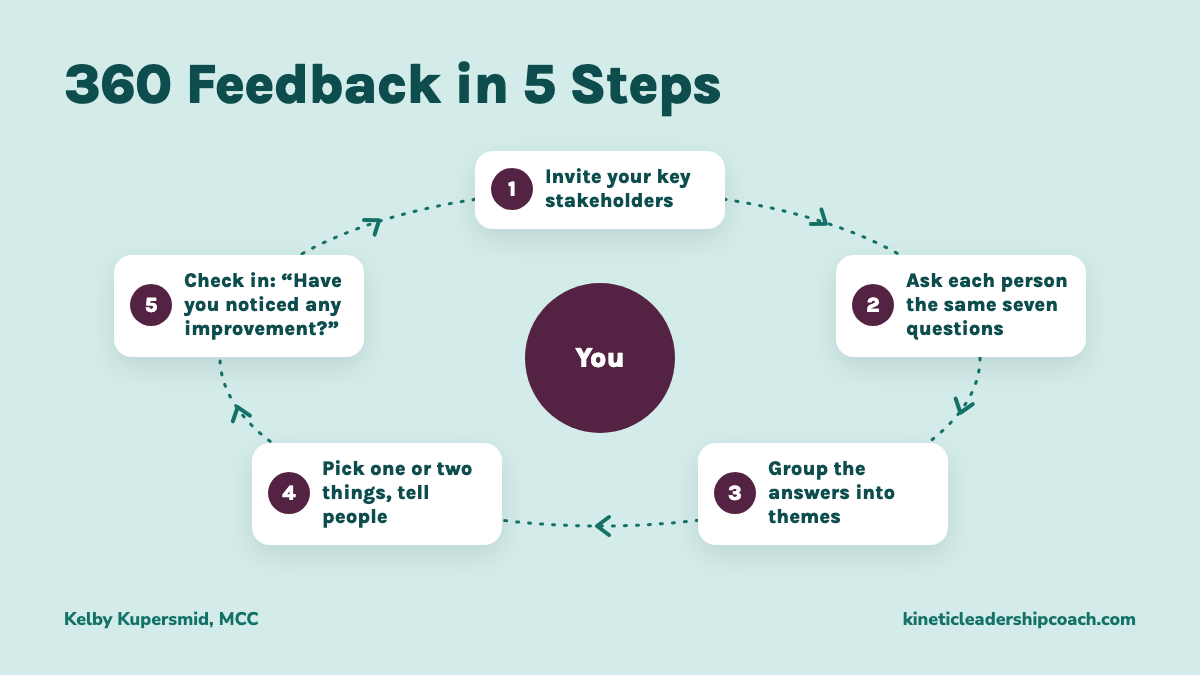
360 feedback is a process for hearing how the people around a leader experience them, including direct reports, peers and someone above them. To run one, invite your key stakeholders, ask each person the same seven questions, group the answers into themes, then pick one or two things to change and tell people what you picked.
You may be thinking your team already tells you what they think, because your door is open. Some of them probably do. The trouble is the part they hold back, since telling the boss something unwelcome carries a risk for them, even if you’re the kindest boss in the world.
Below are the invites, my seven questions and probes, the report layout and the words to say afterward. To show each step on one case, I’ll use the example one-page growth plan from my 1:1 executive coaching page. It belongs to a founder and CEO and was built from 8 colleague interviews.
What is 360 feedback?
360 feedback collects input about one leader from several directions at once, usually direct reports, peers and a boss or board member. You can gather it with a survey or with interviews, and I use confidential interviews because they surface specific behaviors that a survey usually misses.
Who should you ask for 360 feedback?
Ask people who see your leadership up close: direct reports, peers, someone above you such as a board member, and ideally at least one person you’ve had friction with. Choose at least three people for any group whose answers you plan to report separately.
For a first round, write down names under these headings:
- Direct reports (at least three)
- Peers, including co-founders (at least three)
- Someone above you, if there is anyone
- One person you’ve had friction with, counted inside one of the groups above
If a group has fewer than three people, combine it with another group before you report anything. In the example plan, the founder’s list came to 8 colleagues. In Team 360, my Executive Alignment Retreat, I interview up to nine colleagues around each leader and use the same minimum of three per group.
Is 360 feedback anonymous if you run it yourself?
No, a 360 you run yourself isn’t anonymous, because you know who said what. If you need anonymity, have someone else do the interviews, take the names out, and give you only the grouped themes.
If you can’t put three people in a group, tell everyone that up front and don’t promise anonymity.
What should a 360 feedback invite say?
A 360 feedback invite should say why you’re doing it, why you chose this person, how long it takes, who will hear their answers, and how to book. Keep it short, and describe the anonymity exactly as it will work.
Here’s my stakeholder invite for coach-led interviews. In the example, all 8 colleagues would get this same message. Before you send it, agree with your coach how answers will be grouped, and if you can’t group at least three people, change the word “anonymous”:
As part of our commitment to ongoing leadership development, I’m hiring an executive coach to work with me. This is an important investment in my own learning and development, and for the continued success of the company.
Part of the process is for my coach to interview some of the people I work closely with to get candid feedback on both my strengths and opportunities for improvement. I’ve identified you as one of my key stakeholders because I highly value your opinion. It will be an anonymous, 30-minute interview with my coach, [coach name].
Are you willing to participate in this process? If so, please schedule time directly with [coach name] at the link here within the next two weeks.
Thank you for your consideration. As always I appreciate your contributions.
If you’re doing it yourself, here’s a version I’ve adapted so it doesn’t promise anonymity:
I’m really committed to my growth and development and know I need an outside perspective to improve. I’m asking some of the people I work closely with for candid feedback on both my strengths and opportunities for improvement, and I’d like to include you because I highly value your opinion.
It’s a 30-minute conversation with me, so it won’t be anonymous. I’ll keep your name out of anything I share with the team, though people may still guess. I’ll send you the questions ahead of time.
Are you willing to participate? If so, please book a time here within the next two weeks: [link]. If you’d rather not, that’s completely fine.
What are the best 360 feedback questions?
The best 360 feedback questions are open-ended, the same for everyone, and cover both strengths and what to change. These are the seven I ask in interviews. Replace X with the leader’s name, or with “me” if you’re asking about yourself:
- When you think of X, what are the first three words or phrases that come to mind?
- What are X’s unique strengths?
- What are their most significant development opportunities?
- What’s the most important thing for them to focus on at this point?
- Looking ahead, how would you like to see them enhance their impact in the organization?
- If there was only one thing they could take away from this, what would you want it to be?
- Anything else you wish I would have asked or want them to know?
In a one-page plan like the example, strengths answers feed “What people count on you for,” and development answers feed “What they haven’t told you.”
Follow-up probes to keep beside you
These are the probes I use when I want to hear more:
- “What would you say is the impact of that?”
- “If you were to imagine them being more impactful with ___, what would you need to see more of or less of?”
- “Anything else that feels unsaid in this category?”
The theme in the example was that people wait for the founder instead of deciding. When an answer points that way, the second probe becomes: “If you were to imagine them being more impactful with decisions, what would you need to see more of or less of?”
If you want this done for your whole leadership team, Team 360 combines confidential 360 interviews, a one-day Executive Alignment Retreat and 90 days or 6 months of follow-up coaching.
How do you get honest answers when you’re the boss?
You get more honest answers when people believe you want them. Tell people why you’re asking, name that it’s uncomfortable, and then receive whatever they say with grace.
Sheila Heen puts it this way: “People won’t give you feedback until they think you actually want it.” A few things help them believe you:
- Be specific about something you already know you could improve. “I know I tend to get derailed in our meetings. I’m curious if you’ve noticed that recently?”
- Ask for advice. Some people find it easier to suggest a way to improve than to tell you what you’re doing wrong.
- Plant a seed. If you already have a trusted relationship with someone, ask them in private whether they’d share a tough piece of feedback in your next team meeting. When others see you take it graciously, they’re more likely to open up.
Script: before the first question in each interview
These are my exact words, and they work whether you or a coach runs the interview:
I know it can feel uncomfortable for some people to give tough feedback, especially to your boss. I want you to know that I really value your opinion, and I value your honesty over your comfort. I would appreciate you being brave and sharing something that might feel a bit edgy.
If the feedback comes in hot, say “Tell me more about that,” and let them finish. Write it down and hold your explanation. If you tend to agree too quickly to end the discomfort, see my guide to people-pleasing at work.
How do you write a 360 feedback report?
Write a 360 feedback report question by question, with the top themes across everyone under each one. Start each theme with one specific quote, add a few bullets, and take out the names.
The first section of my reports is called “Leadership Brand.” It lists the answers to question one and counts the repeats, so a word three people used gets “x3” next to it. Copy this layout into a document:
360 Feedback Report: [name], [month and year]
People interviewed: [number], in these groups: [each group with three or more people]1. Leadership Brand
[word or phrase] x[number of people who said it]
[word or phrase] x[number]2. Unique strengths
Theme: [name of theme]
“[one specific quote, with identifying details removed]”
– [supporting point]
– [supporting point]3. Development opportunities
[same layout: theme, quote, bullets]4. Most important focus right now
[same layout]5. Enhancing impact in the organization
[same layout]6. The one thing to take away
[same layout]7. Anything else
[same layout]My one or two commitments
1. [what people will see me do more of or less of]
2. [what people will see me do more of or less of]
Before you share anything, read each quote and ask whether the team could guess who said it. If they could, reword it or leave it out.
Once the full report exists, boil it down to one page. Here’s how the example plan reads:
1. What people count on you for
You make the mission feel possible. People stay because of how clearly you see where this is going.2. What they haven’t told you
They wait for you instead of deciding. They’ve learned you’ll redo it anyway, so they bring you drafts and hold back their opinions.3. The two things worth changing
Name the owner, then stay out.
Say the hard thing the same week.
If that second section sounds familiar, my post on what your team needs to see you do as CEO goes deeper on it.
What should you do after you get 360 feedback?
Thank everyone, choose one or two things to work on, and share those commitments with the people you asked. Then check in with them every so often to find out whether they’ve noticed a change.
Look for a theme that came from several people and matters for where the company is going. Keep the raw complaints to yourself, because repeating them invites guessing about who said what.
Choose something people can see. “Be a better delegator” is hard to notice. “Name the owner, then stay out” is easy to notice, which is why the example plan words it that way. If your theme is about holding on to too much, my guide to delegation for founders covers how to hand work over.
The same week, send a short thank-you. A suggested wording: “Thank you for taking the time to give me feedback. I appreciate your honesty, and I’ll tell you what I decide to work on.”
Script: in the team meeting where you share your commitments
Suggested wording, filled in with the example plan’s two changes:
I’ve gone through everyone’s feedback, and I’m going to work on two things. When something needs a decision, I’ll name the owner and then stay out of it. And when I have something hard to say, I’ll say it the same week. If you catch me slipping on either one, please tell me.
Script: in a later 1:1
These are my exact words, with X and Y filled in for the example:
A while back you gave me feedback that people wait for me instead of deciding. I really took it to heart and have been focusing on naming the owner and staying out. Have you noticed any improvement? What advice do you have for me to continue growing in this area?
When should you bring in someone else to run 360 feedback?
Bring in someone else when people are unlikely to tell you the hard parts directly, when you need real anonymity, or when several leaders are doing it at once. Sometimes, especially for the feedback you most need to hear, it’s easier to say it to a third party.
If you’re working on one relationship or one habit, asking directly may be enough. If you’re weighing outside help, my post on what an executive coach does and how to hire one covers the questions to ask first. If the same friction keeps showing up between several of your leaders, a 360 on you alone will only cover part of it. My guide to leadership team alignment explains how I run 360 interviews for a whole team before a retreat.
If at least four leaders run parts of your company and you want everyone, including you, to get this kind of feedback, Team 360 is built for your team.
Frequently asked questions
How many people should give 360 feedback?
Plan for at least three people in each group you report on, such as direct reports or peers. In Team 360, Kelby Kupersmid interviews up to nine colleagues around each leader.
How long does a 360 feedback interview take?
Plan for 30 minutes per person. That’s how long each interview takes in Team 360.
Can I run 360 feedback on myself?
Yes, you can ask people directly using the same seven questions. It won’t be anonymous because you’ll know who said what, so say that in the invite. If you need anonymity, ask a third party to do the interviews and group the answers.
What if my team is too small for anonymous 360 feedback?
Combine groups until each one has at least three people, such as reporting co-founders and direct reports together. If you still can’t get to three, tell people it isn’t anonymous before they answer.
Will 360 feedback be mostly negative?
Often it isn’t. Founders often say it’s the most positive feedback they’ve gotten in their whole careers. The questions ask about strengths as well as development opportunities.
Do I have to act on all the feedback?
No. Feedback is one person’s perspective, and you decide what to change. Pick one or two things, share those commitments with the people you asked, and check in with them later.
Apply for a call if you’d like to talk through running a 360 for yourself or your leadership team.

Kelby Kupersmid, MS, MCC
Kelby Kupersmid is a Master Certified Coach (MCC) who helps founders become CEOs and leadership teams work as one. He has coached leaders for 13+ years across 35+ countries.
Master Certified Coach (MCC), the International Coaching Federation’s highest credential · M.S., Global Business Leadership · Former program manager, Center for Creative Leadership
Published November 25, 2026