 Kinetic Leadership Development
 Kinetic Leadership Development
Jump to section
- What does an executive coach do?
- How does executive coaching work, step by step?
- What is the difference between an executive coach, a therapist, a mentor and a consultant?
- When should a founder hire an executive coach?
- How much does an executive coach cost?
- How do I choose and hire an executive coach?
- What should I do before I talk to an executive coach?
- What else do people ask about executive coaching?
An executive coach is a trained professional who works one-on-one with a leader to change how they lead, using what the people around them see and the real decisions they’re facing right now. If you’re a founder whose company now needs more from you than you can give by working harder, hiring an executive coach is usually worth a serious look.
You may be telling yourself you’ll get through this stretch on your own, and that’s a fair instinct, since it’s how you built the company. The catch is that the habits slowing you down now are often the ones nobody around you will mention.
I’m Kelby Kupersmid, a Master Certified Coach, and most of the leaders I work with are founders becoming CEOs. Below is how the process works, when to hire a coach, and the seven questions I’d ask on a first call. I’ll follow one example the whole way through: the sample growth plan for a founder and CEO on my 1:1 executive coaching page.
What does an executive coach do?
An executive coach helps you see how you lead, pick the few changes that matter most, and practice them in your real work until they hold. It works on the decisions, conversations and habits you already have.
Part of the job is getting information you can’t get yourself. The more people you lead, the less they tell you, because people edit what they say to the person in charge. So the habits that hold you back are often the ones nobody mentions, and working harder can make you better at them.
How does executive coaching work, step by step?
Executive coaching starts with an honest picture of how you lead, narrows to two or three changes, then moves into your real work until those changes hold. Here are the five steps in my process, with the same example applied to each.
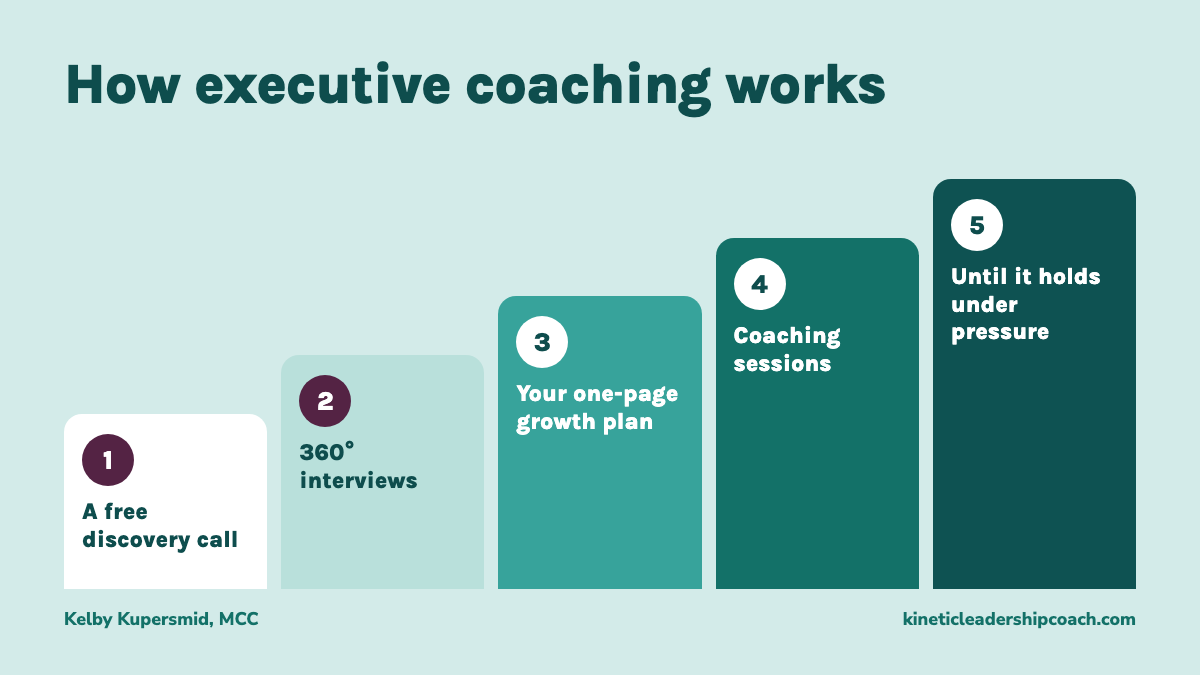
1. A free discovery call
You bring the goal that matters most and the problem that won’t go away. You leave with a clear first move, whether or not we work together.
In the sample plan from my coaching page, the leader is a founder and CEO. It’s a sample, not a real client, and the steps below show how each part of the process would apply to it.
2. Confidential 360° interviews
I interview people who see you lead up close, confidentially. I report themes and never who said what, so people can be honest. Then, in a private debrief, we go through what they count on you for and what’s costing you.
In the sample plan, the input is eight colleague interviews. Before conversations like these, your team should hear about them from you first. Here’s suggested wording.
Script: in the team meeting, when you announce the 360 interviews (suggested wording)
“I’m working with an executive coach on how I lead. Part of that is my coach interviewing a few of you about what I do well and what gets in your way. My coach will give me themes and won’t tell me who said what. If you’re asked, I’d really like you to be straight with them.”
Then send the formal invite. My 360 feedback template has the full stakeholder invite I use for coach-led interviews.
3. Your one-page growth plan
We pick the two or three changes that will free up the most, and write them down on one page, short enough to remember in the middle of a hard week.
Here’s the sample plan from my coaching page, for a founder and CEO, built from eight colleague interviews:
- What people count on you for: “You make the mission feel possible. People stay because of how clearly you see where this is going.”
- What they haven’t told you: “They wait for you instead of deciding. They’ve learned you’ll redo it anyway, so they bring you drafts and hold back their opinions.”
- The two things worth changing: “Name the owner, then stay out.” “Say the hard thing the same week.”
The second section leads to the third. If people bring you drafts because they expect you to redo them, the change is to name who owns the work and leave it with them. If you usually say yes to everyone, the second change is where most of the effort goes. My guide to people-pleasing at work covers why that conversation keeps getting pushed to next week.
4. Coaching sessions on the real work
Private 1:1 sessions on video, in English or Spanish. You bring the real decision, the real person, the real meeting. We find the belief that keeps you doing it the old way, and you leave knowing what you’ll say or do, and when.
The sample plan doesn’t name a belief, but the one behind redoing people’s drafts is a common one. For most of us, it comes from thinking that we provide value by doing. As a CEO, your value comes from evoking, or bringing out greatness in your team. So a session might end with the words for the next time someone brings a draft.
Script: in the 1:1, when someone brings you a draft to decide (my words)
“I notice you’re waiting for me to decide. Is that true?”
“Starting this week, ___ is yours. I’m moving that time to ___. If it comes to me, I’ll send it to you.”
The second line is “name the owner, then stay out” said out loud. The mistake is asking the question and then answering it yourself. Ask it, and wait. My delegation guide for founders covers handing work off so it stays handed off.
5. Until it holds under pressure
Each session starts with what happened. We stay on the same two or three changes until you do them without thinking.
Applied to the sample plan, each session would open with two checks. Did you name an owner this week and stay out? Did you say the hard thing the same week, or did it slide? Whichever slid is the work for that session.
For many founders, this is the shift from founder to CEO. My Founder vs CEO post covers what your team needs to see you do instead.
What is the difference between an executive coach, a therapist, a mentor and a consultant?
An executive coach helps you change how you lead at work, starting from your goals and from what others see. A therapist works on your mental and emotional health, a mentor shares what worked for them, and a consultant gives you answers or does the work for you.
These overlap, and plenty of founders use more than one:
- A therapist is the right call if the main thing in the way is your health, your past or your relationships outside work. If you’re mostly running on empty, start with my guide to founder burnout.
- A mentor helps when you want advice from someone who has done your job. You’ll usually get their way of doing it.
- A consultant helps when you need expertise you don’t have, like a pricing model.
- An executive coach helps when you suspect you’re part of what’s in the way and want to act differently in real situations.
Coaching also gives a founder a straight read on themselves. A leader I coach, who built her organization from the ground up, put it this way: technically the board is her boss, but “No one ever checks in on me.” When nobody is above you, it helps to have someone whose only job is to tell you what they see.
When should a founder hire an executive coach?
A founder should consider hiring an executive coach when the company needs more from them than it used to, and doing more of what worked before isn’t closing the gap. The common signs are a decision you keep putting off, work you can’t hand over, and the feeling that you’re figuring it all out alone.
Here’s how leaders have put it on calls with me. A nonprofit executive director said on a discovery call that she had “recently hit a wall, especially with the management aspects of the organization, and it just seems like a good time to maybe consider bringing on an executive coach because there’s only so much I can do through HR.” On the same call she said, “I feel so out of my depth.”
A real-estate business owner told me, “And where I get stuck is, yeah, delegation is terrible.” A business owner raising investors asked, “I still don’t know what I’m doing?” And in a coaching session, a nonprofit executive director I coach said, “I think the biggest challenge really is that I do a lot of this alone.”
It’s probably not the right time if:
- You want someone to hand you the answers.
- You’d rather your team didn’t know you’re working on this, since I’ll be interviewing some of them.
- The problem is between your executives and not in how you lead. In that case, start with leadership team alignment, or look at the Executive Alignment Retreat for your whole leadership team.
For a free first step, the Delegation Filter Workbook shows where you’re the bottleneck: you sort last week’s work into what only you do, what you check, and what you hand off completely.
Get the free Delegation Filter Workbook
How much does an executive coach cost?
The cost of an executive coach depends mostly on how long you work together and what the engagement includes. The fastest way to get a real number is to ask the coach on a first call.
For my own executive coaching, it depends on how long we work together, and you’ll get exact numbers on the free discovery call. When you compare coaches, the price usually moves with the length of the engagement, whether confidential 360 interviews are included, whether it’s 1:1 or a group, and the coach’s experience and credential level.
How do I choose and hire an executive coach?
To hire an executive coach, talk to two or three coaches, check their credentials, and pick the one who will tell you the truth about how you lead. Most offer a free first call, so use it to see how they work.
Start with credentials. The International Coaching Federation (ICF) has three levels of individual credential: Associate Certified Coach (ACC), Professional Certified Coach (PCC) and Master Certified Coach (MCC), the highest. Each asks for more training, coaching hours and assessment. You can look a coach up in the ICF’s online directory.
For context: I’m an MCC, I’ve coached leaders for 13+ years in 35+ countries, and I previously managed large international programs for the Center for Creative Leadership.
A credential doesn’t tell you whether you’ll work well together, so the first call matters.
Script: on the first call with any coach, the seven questions to ask
- “How do you find out what I can’t see about myself? Will you talk to people who work with me?”
- “What will we be working on in the first month?”
- “How do you decide which changes to focus on?”
- “What do you do when I don’t follow through on what I said I’d do?”
- “How is confidentiality handled, for me and for anyone you interview?”
- “What exactly is included, how long do you recommend and why, and what happens if we finish early or need more time?”
- “Have you worked with founders at my stage, or with leaders facing what I’m facing?”
Listen for specifics. Using the sample plan, a good answer to the first question sounds like the eight colleague interviews, and a good answer to the third ends in two or three short changes. If you leave the first call with a clear next step, that’s a good sign of how sessions will go.
What should I do before I talk to an executive coach?
Before you talk to an executive coach, write down the one goal that matters most and the one problem that won’t go away. Then look at last week’s calendar and notice what you did that someone else could have done.
That second step is what the free Delegation Filter Workbook is for, and it makes the first conversation with any coach more useful.
Get the free Delegation Filter Workbook
What else do people ask about executive coaching?
People usually ask about confidentiality, cost and what to do if coaching didn’t work before. Here are short answers.
How much does an executive coach cost?
It depends mostly on how long you work together and what’s included. For my executive coaching, you’ll get exact numbers on the free discovery call.
Is executive coaching confidential?
Yes. What you say stays between us. In the 360, I report themes and never who said what, so people can be honest.
What if I’ve tried coaching before?
Ask yourself whose view you worked from. If it was only yours, you worked on the parts you could already see. That’s why I start with the people around you.
How do I hire an executive coach?
Talk to two or three coaches, check their credentials (the ICF levels are ACC, PCC and MCC, with MCC the highest), and ask how they’ll find out what you can’t see about yourself. Choose the one who will tell you the truth about how you lead.
Apply for a call if you’d like to talk about working together.

Kelby Kupersmid, MS, MCC
Kelby Kupersmid is a Master Certified Coach (MCC) who helps founders become CEOs and leadership teams work as one. He has coached leaders for 13+ years across 35+ countries.
Master Certified Coach (MCC), the International Coaching Federation’s highest credential · M.S., Global Business Leadership · Former program manager, Center for Creative Leadership
Published November 27, 2026